

Absorption is a long-standing weakness in the nutraceutical industry. Many valuable ingredients dissolve poorly, break down during digestion, or pass through the body without being absorbed. Industry absorption efficiency typically sits at about 20–30%, which means most of every dose is lost. This creates problems across the business:
The client asked a direct question: is there a better way to deliver these ingredients so more of them are absorbed?
The industry already uses several techniques to improve absorption, including liposomal encapsulation, micellar and emulsion systems, phytosome complexes, and other carrier-based methods. Each has helped, but each involves trade-offs in cost, stability, clean-label compatibility, manufacturing complexity, or absorption gains that level off.
Finding something better through traditional lab work alone is slow and expensive. The number of possible combinations of carrier materials, particle sizes, loading levels, and process conditions is very large, and each physical experiment takes time and money.
The client didn’t need hours of consulting or a research report. They needed a credible answer to their question. Under Accubits’ Outcome as a Service model, the engagement was defined by that result: identify a delivery approach that meaningfully outperforms current industry methods, with clear targets for what counts as a success. This kept both sides focused on the goal rather than on activity. It also gave Accubits room to choose the best way to solve the problem, and that way turned out to be AI.
Accubits did not manufacture a product. It built the intelligence layer that points the client to a better process.
1. Turned the problem into measurable targets. The client’s goal was converted into specific formulation parameters linked to absorption: encapsulation efficiency, active loading, particle size, and bioavailability. Each parameter had a minimum threshold, or “gate,” that a candidate approach had to meet.
2. Built an AI-based formulation evaluation system. Accubits developed a system that models how different delivery approaches are likely to perform against those parameters. Instead of testing options one at a time in a lab, the system compared a wide range of candidate processes, including established methods such as liposomal delivery, to find where improvements were possible.
3. Identified a new nano-formulation approach. From this analysis, the system recommended a new nanoscale formulation approach. It is designed to protect the active ingredient, load more of it per unit, and improve how well the body absorbs it.
4. Checked the recommendation against every target. The recommended approach was assessed against all four gates, and its projected performance cleared each one.
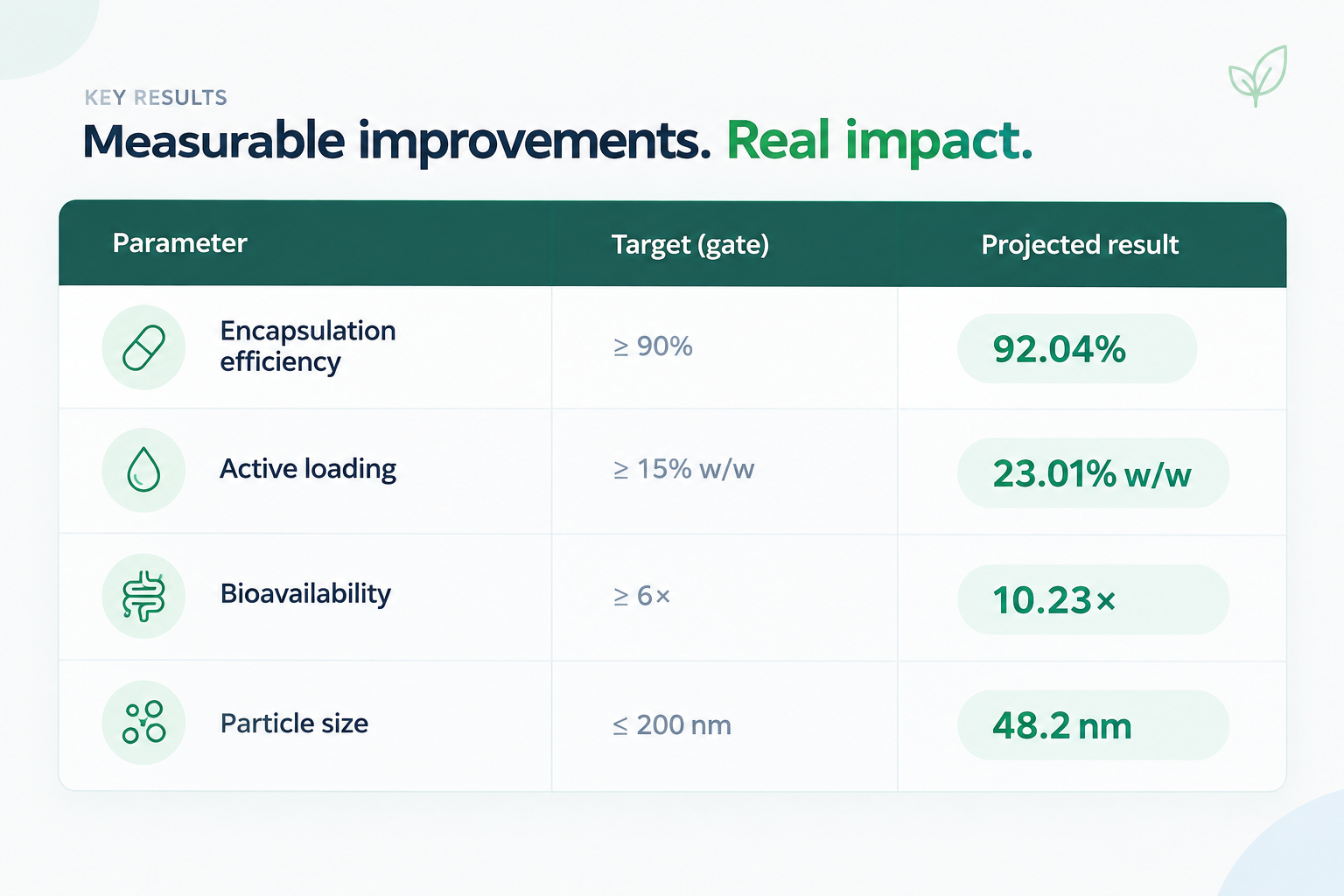
In plain terms:
Overall, the approach theoretically delivers about 25% more absorption efficiency than current industry-standard methods.
The recommended approach is now ready for laboratory and clinical validation to confirm the projected results under real-world conditions.
Outcome as a Service is Accubits Technologies’ engagement model for complex problems where the result matters more than the process. Clients define the outcome, and Accubits takes on the thinking, engineering, and technology needed to reach it.
Want to see the model applied to another discovery problem? Read our hypothetical case study, What if we could cut drug discovery screening time by 80%?
Have a problem you haven’t been able to solve? Contact us.
